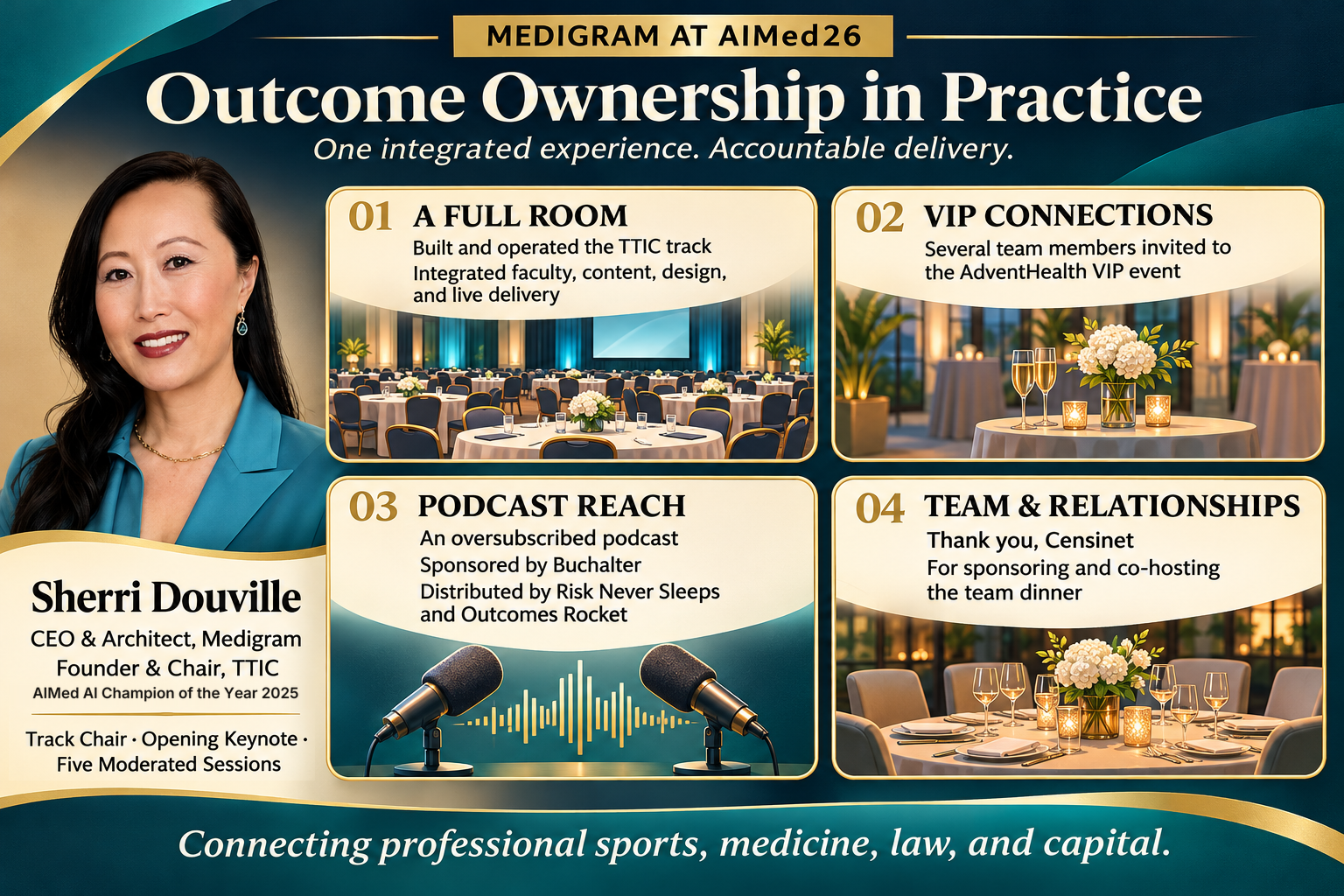
Expertise contributes to an outcome. Ownership means making the complete undertaking work.
At AIMed26 in Orlando, Medigram’s leadership put that distinction into practice through the design and delivery of the Trustworthy Technology & Innovation Consortium’s High-Reliability Agentic AI track.
The purpose was to connect professional sports, medicine, technology, law, and capital around a consequential question:
What must be true before an institution can responsibly depend on consequential AI?
For Medigram, these connections matter because dependable AI requires more than technical capability. It requires clinical judgment, legal authority, operational readiness, credible evidence, and the resources to sustain implementation.
Designing and delivering the whole program
As Medigram’s CEO & Architect and TTIC Founder & Chair, I owned the track’s design and delivery: assembling the faculty and event team, developing the integrated program, and building the control tower supporting live operations.
I also developed the integrated presentation deck, connecting the speakers’ contributions through a cohesive narrative and visual design, delivered the opening keynote, and moderated five sessions.
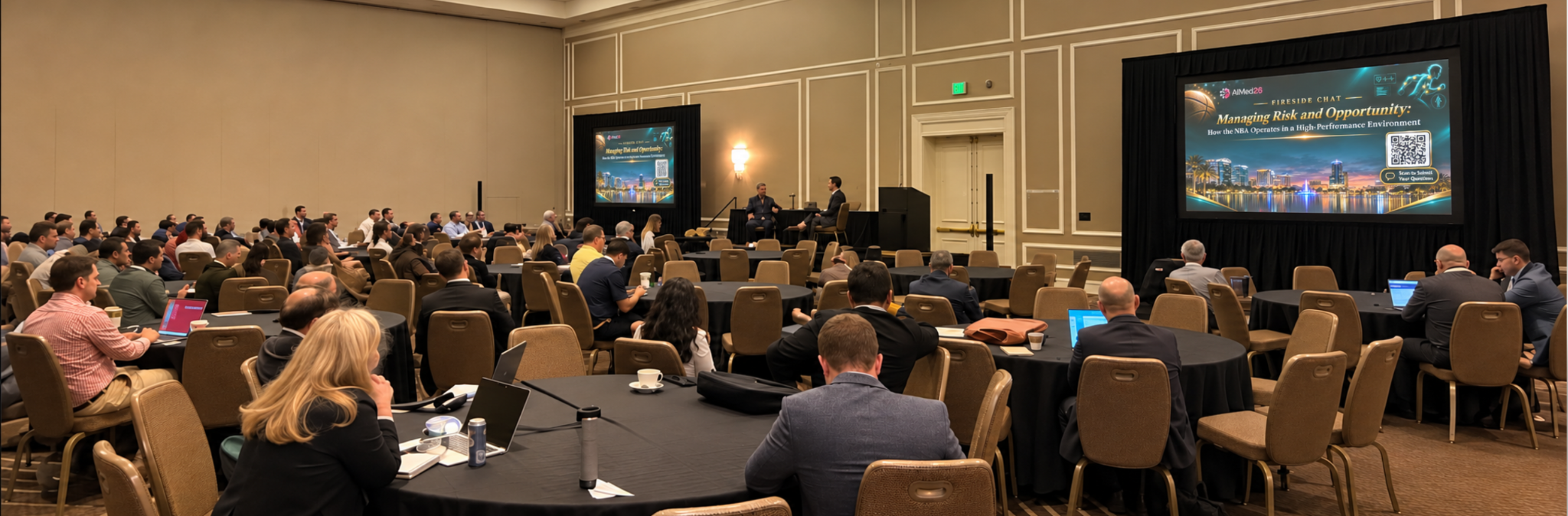
Those sessions addressed clinical and legal accountability, the transition from research to enterprise, capital stewardship, evidence and assurance, and the closing synthesis. Brian Yam led the professional sports programming and moderated the NBA fireside with Matt Brooker. A key member of the event team and an AIMed26 Rising Star finalist, Brian also supported stage management and live execution.
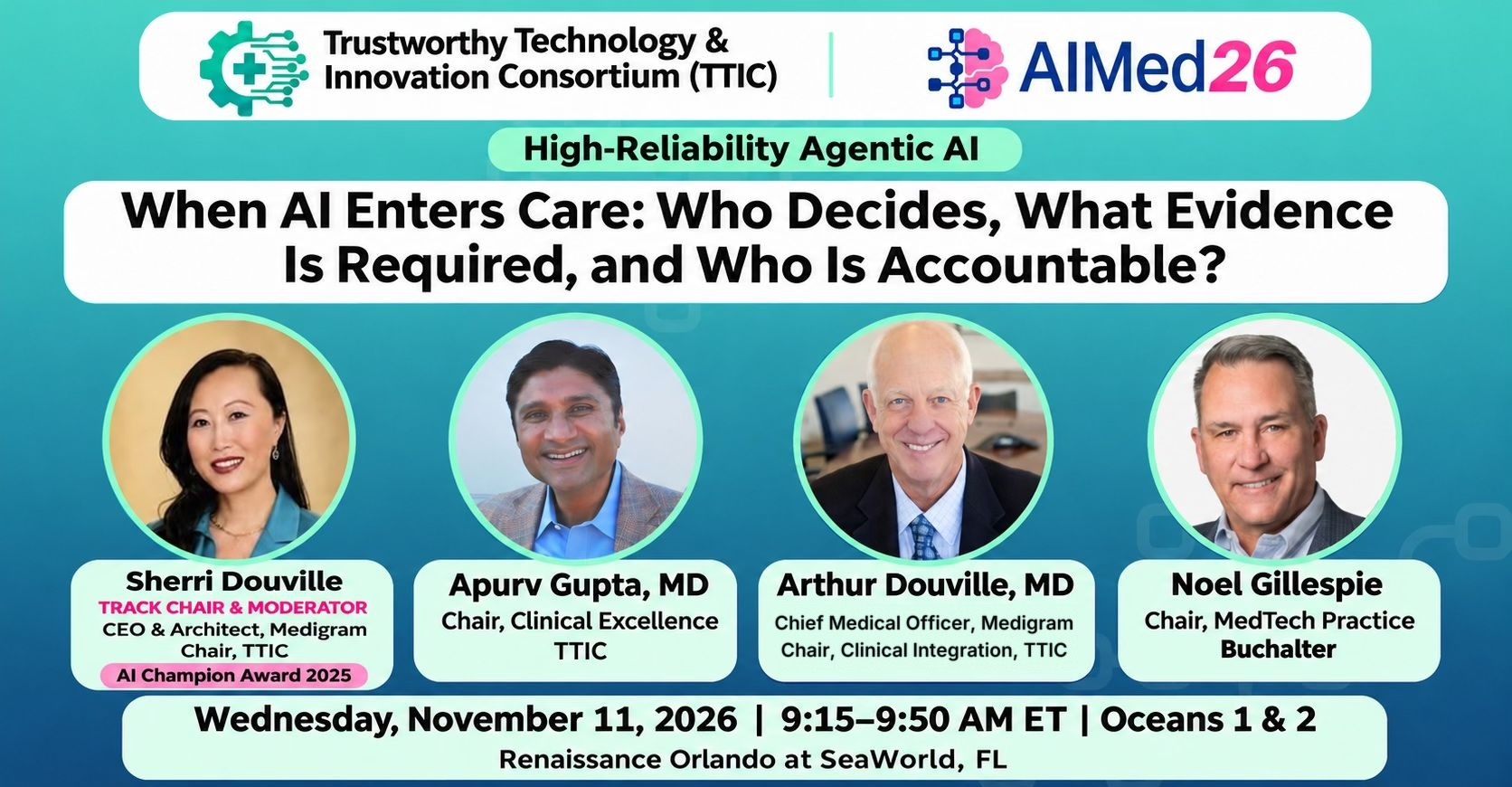
The team delivered the program with AV support from AIMed. Arthur Douville, MD, Medigram’s Chief Medical Officer, brought clinical leadership to the panel’s examination of decision authority, evidence requirements, and accountability when AI enters care. His contribution grounded the discussion in independent physician judgment and patient safety, alongside Apurv Gupta, MD, and Noel Gillespie, with Sherri Douville moderating.
The work demonstrated what outcome ownership requires: extreme attention to multiple layers of detail, anticipation of their dependencies, verification of readiness, and follow-through across the complete undertaking.
The operating capability reliable AI demands
Our track brought together what reliable AI demands: people able to connect requirements, decisions, and evidence while preserving each domain’s authority.
That is a demanding operating capability, not something a title or an impressive résumé reliably demonstrates.
It remains difficult for many organizations to execute consistently. We argue that this capability is a prerequisite for translating AI investment into dependable enterprise value and measurable ROI.
Why professional sports is strategic to healthcare
Professional sports belongs in this conversation as a healthcare ecosystem in its own right. Teams depend on physicians, hospitals, rehabilitation specialists, researchers, and technology providers to make consequential decisions about health and performance.
These relationships are established, but their scope continues to expand. Mayo Clinic’s collaboration with the Minnesota Timberwolves and Lynx connected team medical care with a sports medicine center serving the broader public. More recently, Sutter Health’s April 2026 partnership with the San Francisco 49ers extended across prevention, screenings, care navigation, and community health, with specialties reaching beyond orthopedics into cardiovascular care, neurosciences, and cancer. [1, 2]
Sports also provides a setting for collaborative clinical research. The NBA, player associations, GE HealthCare, and MedStar Health conducted a longitudinal pilot involving NBA G League players to study training and game load alongside musculoskeletal and joint health. [3]
The strategic importance is expanding across three connected areas: care delivery, evidence generation, and access to communities. These examples illustrate that expansion; they do not establish a measured industry-wide rate of acceleration.
As performance and health decisions draw on more data and technology, institutions must address who may use the information, what evidence supports a decision, who retains clinical authority, and when intervention is required. Athlete research must also be evaluated for its applicability before being generalized to other patients.
For Medigram, professional sports is therefore both a prospective customer market and a bridge to healthcare institutions and research partners. Its demanding decisions make governance, evidence, and accountability concrete. The opportunity is to serve those requirements with appropriate infrastructure, not to assume that visibility or a sports relationship establishes clinical effectiveness.
Why these bridges matter to Medigram
Medigram builds governance and evidence infrastructure for consequential AI. That work must connect to the institutions, professionals, and decisions it serves.
Medicine establishes requirements for clinical judgment and patient care. Law clarifies authority and accountability. Capital brings distinct questions at different stages, from financing innovation to sustaining institutional capability and long-term value. Professional sports connects these responsibilities in an environment where health, performance, and organizational exposure intersect.
Our investment of leadership time had a specific purpose: contributing to a substantive institutional discussion while building relationships across the domains on which dependable adoption relies.
A full room and an experience beyond the track
The track drew a full room and overwhelmingly consistent positive feedback. Several team members expressed interest in returning next year, and several industry leaders contacted TTIC about participating in the next track.
The experience extended beyond the formal program. Several team members received invitations to the AdventHealth VIP event, creating additional opportunities for conversation across the AIMed community.
An oversubscribed podcast program extended those conversations further. Buchalter sponsored the podcast, with distribution through Risk Never Sleeps and Outcomes Rocket. We thank Noel Gillespie, Ed Gaudet, Mark Gaudet, Saul Marquez, Outcomes Rocket, and Heroic Voice Academy for their respective contributions to sponsorship, coordination, production, and distribution. Heroic Voice Academy also helped prepare us for the stage.
Thank you to Censinet for sponsoring and co-hosting the TTIC team dinner. Censinet, an AIMed26 Company of the Year finalist, helped create space for the relationships and substantive exchanges that complement a strong program.
We are also grateful to the broader AIMed community, conference leadership, and sponsors, including presenting sponsor AdventHealth.
Independent expertise and clear boundaries
The faculty participated in an independently governed TTIC program, bringing their own expertise and perspectives. Their participation did not constitute endorsement of Medigram or its products.
TTIC’s editorial policy governed content review, evidence standards, disclosures, and independence. Sponsorship did not confer editorial control or scientific endorsement. The healthcare and sports partnerships cited above are external examples, not claims of Medigram affiliation or endorsement.
The complete faculty recognition, institutional insights, and program account are available in TTIC’s AIMed26 recap, “Institutional Success Requires More Than Expertise.”
From the conversation to implementation
The same questions that shaped the track are central to Medigram’s work with Darwin:
- What may the system do, and within which operating boundaries?
- Who has authority over consequential decisions?
- What evidence must be captured to make those decisions defensible?
- When must a person intervene, reassess, or stop?
Our responsibility is to build infrastructure that helps institutions implement applicable requirements and preserve verifiable evidence. Institutions retain their clinical judgment, management responsibilities, and ownership of outcomes.
AIMed26 gave us an opportunity to demonstrate that discipline through a complete program, contribute to the wider institutional conversation, and strengthen relationships relevant to Medigram’s work.
To discuss automating the implementation of applicable standards through Medigram’s governance and evidence infrastructure, contact Sherri Douville on LinkedIn.
Sources
[1] Mayo Clinic. “Mayo Clinic, Minnesota Timberwolves & Lynx Announce Collaboration.” February 4, 2014. Read announcement
[2] Sutter Health. “49ers tap Sutter Health as official healthcare partner.” April 22, 2026. Read announcement
[3] GE HealthCare. “NBA, NBPA, and NGBPU Collaborate with GE HealthCare and MedStar Health on Musculoskeletal and Joint Health Study.” May 13, 2024. Read announcement